Wednesday, November 13, 2013

Mechanical Engineering (Ethical Argument)

Introduction
Mechanical engineering is a pretty easy field when it comes to the workers themselves. There is almost no corruption and most mechanical engineers are friendly, willing to help and work together. The ethical argument is not with the engineers themselves but with the product or structures they are working to improve or maintain. A great example is the power plant in Sherburne county (Minnesota). With the most recent push for "green" or "renewable" energy there has been a push to retire the states largest power plant The Sherburne plant (or more commonly known as Sherco) is the states highest producer of carbon and ranks 21st in carbon production national. So is it as simple and easy as to just shut down the Sherco plant with this ethical dilemma?

Background
Information gathered from Xcel Energy's website and pervious information gathered while I was working for Xcel states that the Sherco plant was originally built in the 1970's having two coal fired boilers turning two turbine generators making 750 megawatts each. (provides power for 650,000 houses each). A third unit was installed in the 1980's and produces 900 megawatts of electricity (power for 800,000 houses). To power all this, 30,000 tons of coal is burned every day this equates to three train loads of coal. With environmental concerns rising Xcel Energy (major owner of the Sherco plant) created a project in the early 2000's that was designed to reduce emissions of its power generating facilities. Sherco was one of the plants that had emission reducing equipment added to the exhaust system. Xcel Energy put over a billion dollars into this emissions reduction program with many positive results.

Ethics
The definition of ethics from the Webster dictionary is "rules of behavior based on ideas of what is morally good and bad". This (I believe) is a very interesting definition of ethics. By this definition everyone in the world has their own set of ethics and there is no clear definition of what is ethical and what is not. For this blog though the ethical issue that is going to be used is that the Sherco plant produces too many green house gases and is a major producer of carbon dioxide which hurts the planets environment. This "hurting the planet" is generally seen as a bad behavior and not ethical. On the other side because the power plant is producing electricity that people need to live and continue with day to day life it can be argued that the power plant is doing its job and ethically it is good for people. The argument comes down to two sides, ethically wrong because it hurts the environment versus ethically justified because it helps people live their day to day lives.

Shutting Down Sherco
Most people enjoy living and would like to protect the planet at all costs.The ethical argument is that because Sherco is one of the largest contributors of carbon that it should be shut down immediately. With improvements is solar energy and wind; why not retire the Sherburne power generating plant and move to these clean forms of energy? With the rising concern about climate change and how green house gases are affecting the environment the obvious answer is to remove the problem and shut down any factory or system that produces these gases. Many mechanical engineers understand this reasoning and agree something needs to be done but many engineers are considered unethical because they are not willing to retire the Sherburne power plant.


Should Sherco Be Retired?
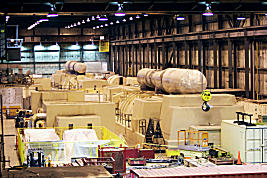
Larger viewABSOLUTELY NOT!!!! From a mechanical engineering standpoint this is a terrible idea. To many people it would appear obvious that Sherco should be retired but many of these people do not have an understanding of how large Sherco is and how much electricity is produced at this power plant. Minnesota has a population of approximately 5 million people, the Sherco plant alone can produce enough electricity for over half these people. To replace this one plant with wind turbines and solar panels is a ridiculous idea at this point in time. A single wind turbine can produce 2-3 megawatts of power at max wind velocity. This also is a problem because as many of us know the wind does not blow all the time and on the flip side to protect the equipment from damage when to much wind is present the turbines have to be locked up and do not produce any electricity at this time. So next choice is solar power, well with the current cost of materials and the area needed to make up for 2,400 megawatts of power is not realistic at this current date; and again the sun does not always shine so at night and cloudy days no electricity is being produced. This also brings up a strong point for the Sherco plant. People wanting to shut the plant down might argue that the power plant does not always operate either. This is true but the Sherco plant has a typical availability factor of 95 percent while the national average is 78 percent. So lets do the math here, people are wanting to shut down a reliable, powerful, top producing plant that has had recent upgrades to reduce emissions just because it is still producing carbon. Any mechanical engineer can look at the data above and see that until a reliable, cheaper, cleaner energy source becomes available that the Sherco plant will be around for a while. In this particular case the ethical reasoning of the plant not being environmentally friendly is over powered by the fact people need and use electricity daily and there are no suitable replacements at this time.
Summary
Mechanical engineers are an interesting group of people and I will be the first to say don't always think about ethical issues. A mechanical engineer is going to do what is most logical and realistic and use that in their decision making. This is a clear case where unless people do not want reliable energy the Sherco plant will be around for the foreseeable future.

Mechanical Engineering (News Analysis)

Introduction
Many people including myself travel over bridges each and every day without giving it a second thought. Recently though bridge failures have been in the news which is something many of us would prefer not to hear. One of the most recent bridge failures happened back in May of 2013; when a bridge in Washington state collapsed. Though no one was hurt in this incident, but it brought back many memories of the 2007 bridge collapse of the I-35 bridge. 

The Article
An article by Fox News titled "Washington bridge collapse caused by truck hitting span, authorities say" was written on May 24, 2013 (Author not given). This is a good article to analyze for mechanical engineers because the article was written using facts that can be proven or statements from people that are involved with the bridge collapse. The article on the I-5 bridge collapse was written days after the event and only presents what had happened and the early thoughts officials have on why the bridge collapsed. The article uses logos (logic) and tends to stay away from emotions or ethics so I believe it is a good article to demonstrate how mechanical engineers are looking at this tragic event.

Background Information
The bridge that failed in Washington state was the interstate 5 bridge that connects Seattle to Canada. This bridge was constructed in 1955 and up to this point in time had not had any issues. The I-5 bridge on average supported roughly 71,000 vehicles a day, many of which were on their way to Canada. The I-5 bridge collapsed into the Skagit River where rescuers quickly responded and pulled three people from their cars following the bridge collapsing. Due to the bridge collapsing traffic issues became a concern between Seattle and Canada with the upcoming Memorial day just a couple days away. With the collapse of the I-35 bridge, many bridges were inspected and their safety was brought into question. The I-5 bridges safety was one of those bridges that received a sufficiency rating of 47 out of a possible 100. Even with this poor rating the bridge should not have collapsed like it had.


Reasoning
Many questions were raised once the survives were rescued and everyone was safe. First was how could another bridge collapse on its own? Did the gusset plates fail again? Could a rating of 47 been wrong and in fact the bridge was in worse shape than originally thought to be?  The first question to be answered was that many people thought that the gusset plates had failed again, well this was a false statement. The section of the I-5 bridge is a different type of bridge compared to the I-35 bridge and the gusset plates should not have been a factor. With the collapse of the I-35 bridge many bridges were inspected to make sure that no other incidents would occur. With this mass inspection of bridges many were found to be in poor condition but all were given a good enough rating to continue to be in service. In fact many people believed that the inspectors were rating bridges on the cautious side and giving worse ratings for bridges than they actually deserved so the rating of 47 should have been a sufficient rating for the bridge and it should not have collapsed on its own. Investigators got their answer as to why the bridge collapsed shortly after starting their investigation. A tractor trailer (Semi) with an oversized load was at the scene when the bridge collapsed. The early report states that the tractor trailer with it’s over sized load struck an overhead beam thus causing the bridge to fail and collapse. This eased many people’s minds knowing that it was human error instead of a design flaw; but it has had an impact on the civil and mechanical engineering fields.


Impact on ME's
This incident has had some impact on both civil engineers and mechanical engineers. Bridges and structures in general are built with a factor of safety so that even with the structure being hit it should not fail. So why did the I-5 bridge collapse? The answer is rather obvious, with the structure receiving a rating of 47 the design engineers never took into account about the age of the bridge and the wear factor that 58 years had on the bridge. With this incident and previous incidents many mechanical engineers are working to ensure that they will not happen again. With new technology and metal alloy blends becoming available mechanical engineers are looking into material that will hold up to the wear and tear of being out in the elements for 50 plus years. Mechanical engineers are also looking into how the factor of safety changes with time. It has become obvious that the factory of safety used for this bridge did not take into account the age of the bridge; so with each incident mechanical engineers are using computer software to help understand how to design and build a better structure with materials that will last. 

Monday, November 11, 2013

Mechanical Engineering (Review)

Introduction
Mechanical Engineers are continuously having to keep up with improvements and changes in modern machinery. 10,000 years ago mechanical engineers were only just starting to understand how machines could be used to complete jobs more efficiently. Thousands of years ago people were learning how leverage can help lift heavy objects or how an incline plane can help a person move an object up to great heights; now a days the studying and technology that a mechanical engineer has goes way beyond these simple machines and I am going to talk about some of the modern technology used today.  

The New Technology
One of the more recent technological improvements in the mechanical engineering field is the use of three dimensional scanners and imputing that data into a computer aided design system. This system is more commonly known as a CAD program. Though CAD programs have been around for a few years, only now are they being used for three dimensional scans. In the past CAD programs have been limited to two dimensions are in the past few years have reached into the third dimension. These programs have helped build buildings, design cars, test certain equipment and have been able to give stress estimates on parts input into the program. This has been a very valuable tool for designing modern machines but what about older systems? Can this CAD program be used to help maximize efficiency in older systems? The answer is yes with new 3-D scanning systems.

Problems With Current System
The current system used for designing machines or building is drawing them out on paper; this has many problems associated with it. The first problem is the lack of the three dimensional view. People see the world in all three dimensions and when designing a product or a building (such as a power plant) it is nice to get a rough idea of what the end result of the project is going to look like. With the current system of drawing in two dimensions forces the drawer to make a minimum of two drawings so the correct information can be attained. Though this is easy to make a second image it is time consuming and creates more chances for errors. This system of designing works and will be needed even with new technology but the addition of the third dimension will reduce the number or errors when the building or product is in the design stage.

The New Scanners
New three dimensional scanners have finally met the standards that industries need. Many builds and machines are extremely complex and hard to visualize without having a picture or a part in your hand. In my experience with three dimensional scanners probes are brought in and placed at several locations. At this point they send and receive signals from the room and are able to create an image of the room the probes are located in. With the most recent update in technology this system is able to give dimensions to items in the room allowing two dimensional to be created and the part to be analyzed more critically. This is most valuable to older buildings that are going under renovations. This technology allows mechanical engineers to come in and make a computer copy of their surrounds and apply their changes to the structure/machine and see if everything is going to work as planned or if there needs to be changes to the design changes. This new technology will drive down cost, mistakes made in the work place cut down on time need for a project. I believe this is an extremely valuable asset to the modern mechanical engineer.

Monday, November 4, 2013

Mechanical Engineering (Explanation of Mechanical Engineering)

Introduction
Mechanical engineering is perhaps one of the greatest and most exciting fields to go into. Most people have heard of engineers before but when it comes to determining what each field does not many people can tell you the difference between each branch of engineering. Mechanical engineers are perhaps the most flexible of all the engineering trades. A mechanical engineer can work on anything from bridges to air planes and anything in between but mechanical engineers tend to deal with mechanical machines for the most part.

Definition
The definition of mechanical engineering from the "Free Dictionary" is "The branch of engineering that encompasses the generation and application of heat and mechanical power and the design, production, and use of machines and tools". Now this is a good definition if you understand what each part of the definition means. Break this definition down, the first part is the generation and application of heat and mechanical power. This means the creation or use of energy; energy in this case is either heat or mechanical power. Mechanical power is the power a machine uses to operate (tires on a car turning from power input from the engine) or the power a machine creates (power plant making electricity). The second part of the definition "the design, production and use of machines and tools" is exactly as it sounds. Mechanical engineers look how to make machines operate at optimal performance by making changes to the design, production (creation) and or the use of the machine. To summarize, mechanical engineers deal with machines and the creation or consumption of energy while optimizing performance.

Values
 The field of mechanical engineering has several values that each engineer must follow. First is involves ethics, are you making the best choice for the company and for the right reasons? Is the cost worth the results? Is this the best way to do this job or is there a more efficient way? All of these questions and many more have to be answered when a mechanical engineer is doing their job. Mechanical engineers need to work with each other to operate at the high rate and getting jobs done effectively and on time. Mechanical engineers (for the most part) look for efficiency, time effective, cost effective and overall value for what is being put in (maximizing as much as possible).

 Due to the need to be flexible, mechanical engineers need to learn a variety of skills and be able to apply these skills to many different work applications. While in school mechanical engineers take classes that deal with physics, chemistry, electrical engineering (Circuits), industrial manufacturing, a variety of calculus classes and many more. For people interested in learning valuable information (and a lot of it) mechanical engineering is a great field to go into.

Career Field
Mechanical engineers have some of the wildest and craziest jobs available right out of college. With the wide range of jobs available, mechanical engineers can have their pick of where and what they would like to work on. If I want to work for a large company dealing with optimizing systems there are plenty of jobs there but if I want to work for a smaller firm and analyze data I can do that as well. These jobs are not only local but world wide. Mechanical engineers are needed everywhere a mechanical machine is located. The best part of being a mechanical engineer is the opportunity to learn and advance in the field.

 Due to the wide range of jobs available for mechanical engineers job placement is not an issue. With good grades and a good work ethic there are plenty of jobs to choose from. With the most recent decline in the economy how many career fields can say they still had plenty of jobs available? Not many, mechanical engineering was and still is one of those fields. This great need for mechanical engineers says something about the profession and the need for good mechanical engineers.